
Introduction:
Previously, we meditated on the passage from the Gospel with which the Evangelist Saint Mark presents his Gospel. Though not as extensive as that of Saint Matthew, Mark´s Gospel does not lack that extraordinary touch of his experience with the missionaries Saint Paul, Saint Barnabas, and above all, Saint Peter. All this richness of the “sayings and deeds of Jesus” has earned him the title of the “Gospel of Wonders”. . https://www.vaticannews.va/es/santos/04/25/s–marcos–evangelista.html
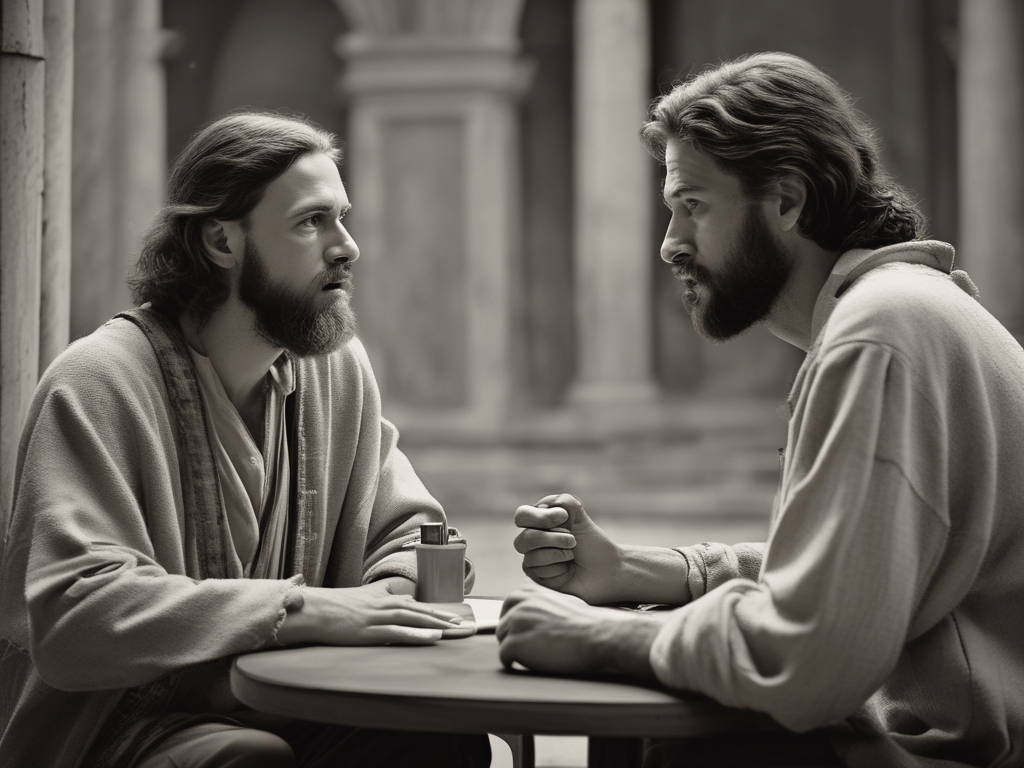
To present his writings, we will conduct a fictional interview with Mark, where he will talk about his person and explain his intentions, plan, theology, and the circumstances in which he wrote his Gospel.
Interview:
Reporter (R): “Good morning, Mark. Thank you for agreeing to explain everything related to your writings.”
John Mark (JM): “I am glad to explain what led me to write about Jesus.”
R: “Could you tell us a bit about yourself and how you got involved in this new religious movement of your time””
JM: “My name is John Mark. John is my Jewish name and Mark is a very unusual Roman name, but as I am from Jerusalem, a metropolitan city, it was very convenient for my missionary life. The name of my mother is Mary (Acts 12:12) and she has a large house where many followers of Jesus gather. This allowed me to be in contact with Jesus from a young age and later with the Apostle Peter, who frequented my house.” (Acts 12:12)
R: “How did you come to know Paul?”
JM: “My cousin Barnabas (Colossians 4:10, Pilgrim Bible) introduced me to Paul with the Apostles, and then they invited me to accompany them on their first missionary journey. At first, I was excited. Imagine, being a missionary of the new Christian community that was already spreading throughout the empire, what a great opportunity! But I think, truly, I was not yet prepared for the difficulties of the journey, and I returned to Jerusalem.” (Acts 13:13, Pilgrim Bible)
R: “Did you have contact with Paul again?”
JM: “Yes, we met on several occasions, and eventually, we regained our friendship. We became so close that Paul called me his assistant.” (Philemon 1:24, The Latin American Bible)
R: “What can you tell us about your experience with Peter?”
JM: “Peter trusted me, and his closeness taught me and deepened my knowledge of Jesus. Peter introduced me as ´his son´(1 Peter 3:13), and of course, his preaching about Jesús is what I wanted to capture in my writings.”
R: “Could you explain the doctrine of your Gospel?”
JM: ¨First of all, I want to present Jesus as the Messiah, the Son of God. That is why my Gospel begins with the narration of the Jordan River. Additionally, in my Gospel, the MESSIANIC SECRET is glimpsed. This secret is revealed through his passion, death, and resurrection.”
R: “How would you describe Jesus?”
JM: “I want to point out that Jesus is a Messiah more powerful that Moses and the prophets. Additionally, he demonstrates his power through miracles and exorcisms, which are an eschatological manifestation of the spiritual order.”
R: “Why do you present Jesus as the Son of God?”
JM: The reality of Jesus is demonstrated by his power to forgive sins, his authority over the Sabbath, and the exorcisms through which he expels demons.”
R: “What role do miracles play in your narrative?”
JM: “I chose eighteen miraculous and very significant miracles. These give a guarantee and a special seal to my narrative. Three of them are narrated in the first chapter as a preparation for the message. Furthermore, in chapter 2, I reaffirm Jesus as the Son of God by presenting him forgiving sins, and attribute that belongs only to God.”
“In chapter 3, Jesus is the Lord of the Sabbath, and in chapter 4, Jesus is the man who needs rest, and so on. All this constitutes what is called THE THEOLOGY OF THE MIRACLES.” (the study of the divine nature and its attributes)
R: “Does the Gospel follow a plan or is it simply a compilation of apostolic preaching?”
JM: “In reality, it has been structure in a systematic way since it has been divided into five parts that cover the life of Jesus from his preparation for the ministry to his passion, death, and resurrection.”
R: “How would you summarize your work?”
JM: “The theology of these writings is summarized in the presentation of Jesus as the Son of God and Messiah through the Messianic Secret, by which Jesus is recognized as the Messiah only after his resurrection. Jesus as the Son of God is powerful as he performs actions that only belong to God.”
“Likewise, he is the Son of Man, and this is demonstrated through his sufferings, humility, rejection, which ends in suffering for the establishment of the Kingdom of God.”
R. “Thank you, John Mark, for your teachings. I believe that from now on, we will be able to understand much better everything you narrate in your Gospel”
Final Reflections:
- Do you think the content of this Gospel has been relevant for generations of Christians?
- Can you remember a passage from this Gospel that has enlightened you?
- Do you think that in the times of social confusion in which we live, this Gospel remains relevant?
- Have the Sunday readings from this Gospel taught you something new for your life?
Proposal for the Week:
I suggest you read a daily passage from the Gospel according to Mark, pause in the reading, and apply a teaching received in the reading to you life. This practice will allow you to delve into the wisdom and message of Jesus and find practical applications for your daily life.
Sources of the Interview:
- Commentary on the Gospel of Mark, Juan Mateo, SJ. Center for Theological Reflection, 1990
- The News according to Saint Mark, Luis Mosconi, Dabar Editions, 1993
 Reflexiones Espirituales
Leave a comment