
Introduction:
We are delving into the narrative of Jesus’ preparation for his ministry. It is crucial that we pay attention to the various scenarios in which Jesus’ preparation for his ministry unfolds. Let us also analyze the significance of this moment in Jesus’ life, and above all, the importance of our baptism and its relevance in our daily lives as Christians.
Galilee:
Jesus’ activity unfolds in Galilee and its surroundings, including pagan lands. He then passes through Perea and Jericho before reaching Jerusalem. Let us remember that Galilee played a significant role in the development of Jesus’ mission. It was where his first disciples came from, where he preached and performed miracles. From Galilee, he journeyed to Jerusalem, where his mission culminated.
In this context, Mark narrates the events to strengthen the faith of the Christians in Rome who were facing persecution and threats. His language, common Greek (Koine, the common Greek language), is straightforward and effective. He uses phrases like “immediately,” “again,” and “and.” He presents Jesus directly and without hesitation.
For the meditation on this passage and the following ones, I will once again use the system of SEE, JUDGE, ACT. Additionally, I will add comments from important figures and writers of the Church such as the Venerable Bede, Saint Jerome, Saint John Chrysostom, Saint Augustine, Saint Thomas Aquinas, and others.
The Baptism of Jesus
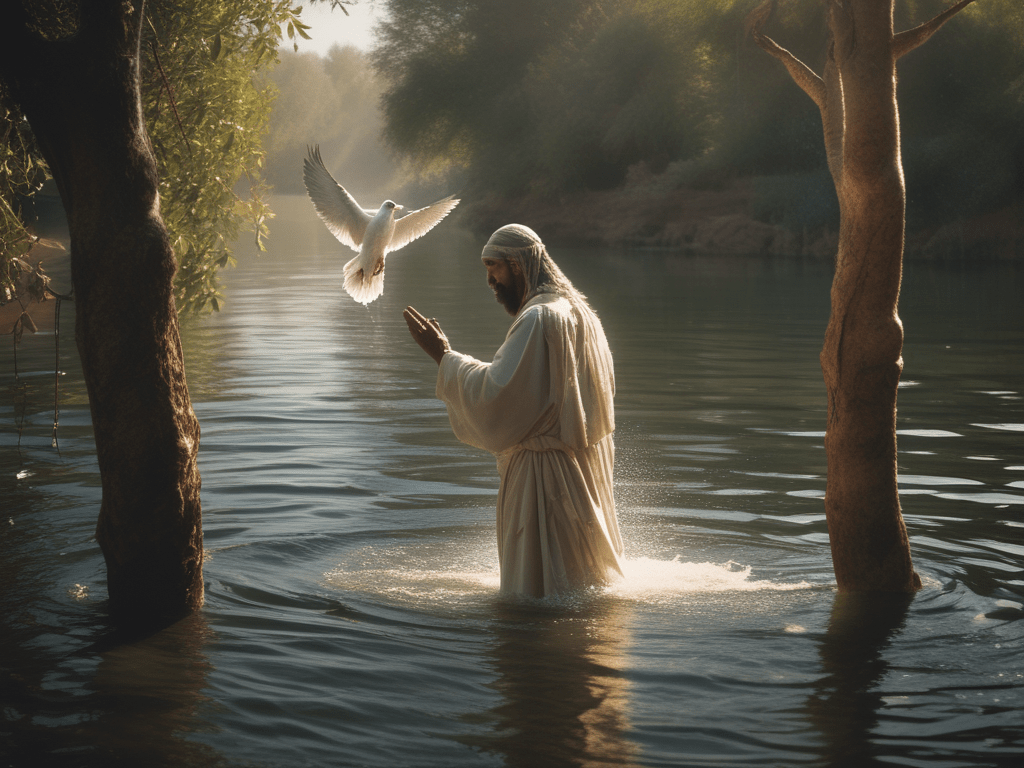
“And it came to pass in those days that Jesus came from Nazareth of Galilee and was baptized by John in the Jordan. And as he came up out of the water, he saw the heavens being torn open and the Spirit descending on him like a dove. And a voice came from heaven: ‘You are my beloved Son; with you I am well pleased.’” (Jerusalem Bible, Mark 1:9-11)
See:
Once again, let’s reread and try to be front-row spectators of this very special event. Jesus descends from Nazareth, a town located in a valley of the low mountains between Cana and Nain, with significant geographical importance as it was halfway between the Mediterranean Sea and the Sea of Galilee. [Source](https://buscandoajesus.wordpress.com/articulos/como-fue-nazaret-en-tiempos-de-jesus/)
The Jordan River:
The Jordan River played a significant role in the lives of the Jews during the time of Jesus. Originating from Mount Hermon and flowing into the Dead Sea, this river was the primary source of freshwater in the region and is frequently mentioned in the Old Testament.
In biblical history, the Jordan River was the point of entry for the Israelites into the Promised Land, marking a crucial moment in the narrative of liberation and divine promise. Additionally, this river played a vital role in the lives of prophets like Elijah and Elisha, who performed miraculous acts in its waters, symbolizing the presence and power of God in the history of the Jewish people.
In the New Testament, the Jordan River retains its spiritual significance as the place where John the Baptist preached and baptized those seeking repentance and spiritual renewal. For Jesus, the act of being baptized in the Jordan River represented a crucial moment of preparation for his public ministry, symbolizing his identification with humanity and his commitment to the divine will.
Starting Point in the Public Life of Jesus
When Jesus arrives at the Jordan River, he is an unknown figure unaffiliated with the religious groups of his time: the priests, Pharisees, and Sadducees. Moreover, he is on the brink of taking a significant step in his life, leaving the land where he grew up and had friendships for a diverse and challenging world that was not welcoming to newcomers. Mark is concise in his narration, yet he does not overlook crucial details for Jesus as he begins his mission.
Many times, in our communities, a similar situation occurs. You arrive at a new parish community with a strong desire to participate and collaborate in pastoral activities, only to encounter individuals who, due to their seniority, see you as a rival and do not allow you to integrate. The right approach would be to recognize the gifts and abilities of new members and encourage, support, and if necessary, prepare them to contribute and develop their gifts to the fullest.
Judging:
The Church Fathers dissect this paragraph in a unique manner: Saint Jerome begins his hermeneutics by comparing Mark’s expression (“and it came to pass”) to a delighted bee during a meadow full of flowers. He then reveals the action of the Holy Spirit anointing Jesus as it descends upon him. Furthermore, he alludes to the effects of the Church’s baptism where we are anointed by the Holy Spirit and declared beloved children of the Father. (Commentaries on the Gospel of Mark, Saint Thomas Aquinas, Ivory Falls Books, p. 12)
From a human perspective, we can compare this Father’s delight in Jesus to a human need that will fill him with strength and energy to endure the persecutions and rejections that will culminate in his passion and death. All of us as human beings need the support of our parents throughout our lives, especially during the challenging moments that we encounter.
Importance of Human Support in Our Lives
This support is of great significance and can be the factor that leads us to success or failure. It is also very necessary, especially when what the child desires may differ from the parents’ plans.
As baptized and anointed as priests, prophets, and kings, we should feel proud to belong to the Mystical Body of Christ and to be children of the Eternal Father. Unfortunately, the majority of the baptized are not aware of such dignity, and many times they feel ashamed of belonging to the Church or at least show indifference.
Acting:
To make this passage our own, we must embrace the words “This is my beloved son/daughter.” In other words, through baptism, we are grafted into the mystical body of Christ and identify with Christ. Therefore, the Father is our Father, and we constantly repeat this in the Lord’s Prayer.
If we believe that God is our Father, it is our filial obligation to live our lives and act at every moment as “beloved children of the Father.” Just as we desire to please the wishes of our natural parents when we truly love them, so should our daily desire be to please our Heavenly Father by following the commandments and, above all, what Jesus came to teach us, “to love our neighbor as ourselves.”
To initiate this change, we can:
1. Pray daily to the Father, asking Him to grant us the experience of His love and support. Remember that personal prayer is the best means of communication with God after the Sacraments, especially the Eucharist.
2. Show interest in your children, grandchildren, and relatives by finding ways to support their desires, dreams, and by discovering their virtues, abilities, and weaknesses. Your “Domestic Church” is important, and by showing interest in its members, you do not need to preach with words because you are doing so through your actions.
3. Be attentive to the needs of others, listen to them, and treat them as true children of God regardless of their race, religion, political or social inclinations.
Final Reflections:
Do you truly believe that God is your Father and loves you unconditionally?
Is there something you wished to do but were not allowed to?
Do you have a child, grandchild, niece, nephew, godchild who needs your emotional support and help?
Do you show physical affection like a kiss or hug to your children?
I hope this reflection has helped you, and I would appreciate it if you could let me know and share this writing with someone.
If you subscribe, you will be able to recieve new articles every week.
I would greatly appreciate your feedback.
God bless us all!
Sources of the Article.
– Catena Aurea, Comentarios al Evangelio, San Marcos, Santo Tomás de Aquino, Ivory Falls Books, 2016
– Biblia de Jerusalén, Editorial Desclée, 1992
 Reflexiones Espirituales
Leave a comment