
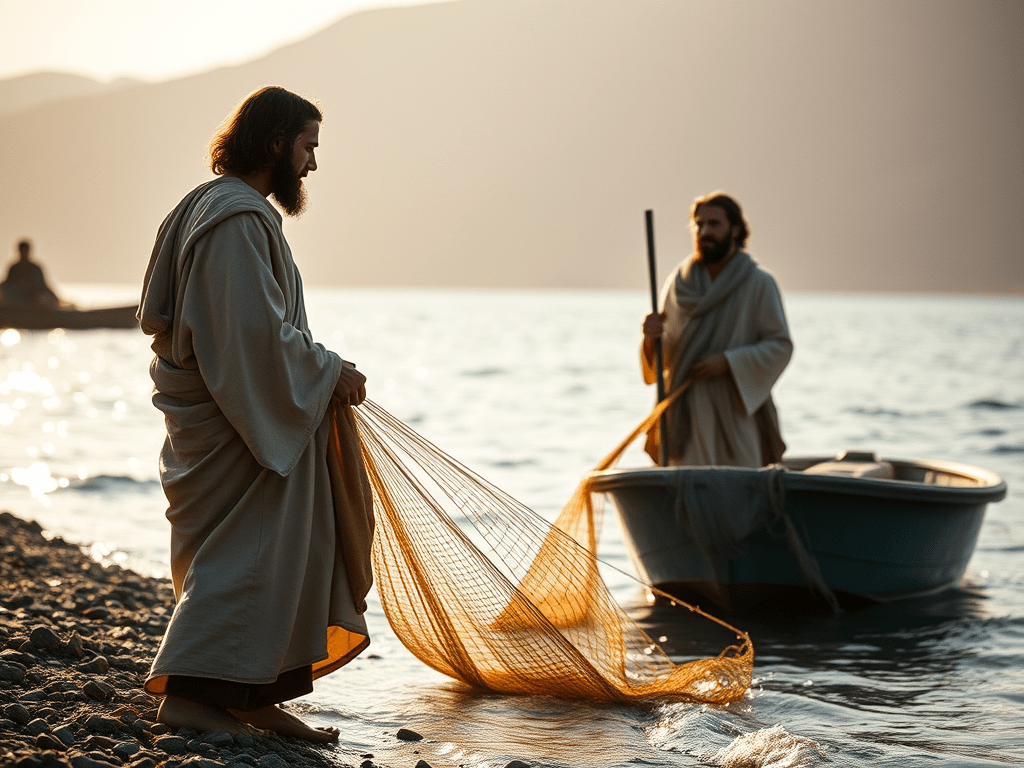
The First Disciples
As Jesus walked along the shore of the Sea of Galilee, he saw Simon and his brother Andrew casting nets into the sea, for they were fishers. Jesus said to them, “Come, follow me, and I will make you fishers of men.” At once, they left their nets and followed him. A little farther along, he saw James, son of Zebedee, and his brother John in a boat, mending their nets. Without delay, he called them, and they left their father Zebedee in the boat with the hired men and followed him. Mark 1: 16-20
Passage Analysis
In this passage, the evangelist Mark presents the crucial moment when Jesus calls his first disciples. This meeting takes place on the shores of the Sea of Galilee, a location that will become the epicenter of his ministry. The choice of fishers as his first followers is not accidental; Jesus seeks collaborators who, despite lacking formal education, have valuable skills such as patience, perseverance, and the ability to work as a team.
Jesus’s initiative is clear: He is the one who calls and directs his gaze toward Simon and Andrew. This act of choice is significant, as it implies an invitation to leave behind their past lives and embark on a new mission. The immediate response of the disciples, who leave their nets without hesitation, reflects a deep faith and radical commitment. This sacrifice is even more remarkable considering that fishing was their means of livelihood and that of their families.
Zebedee´s Sons
Similarly, the call to James and John, who also leave their father Zebedee, highlights the urgency and importance of the mission that Jesus proposes to them. The phrase “I will make you fishers of men” suggests a transformation of their vocation; now, their work will be to draw others toward the message of the Kingdom of God. This metaphor of “fisher of men” implies not only the search for souls but also the need for patience and dedication—qualities that fishers already have.
Jesus invites them to continue their trade on a different level. Although they likely did not have formal academic education, they possessed the essential qualities of a fisher: sleepless nights, patience, and the ability to stay undiscouraged. They often spent long hours casting their nets, and despite not always achieving results, they persisted in their work, knowing that their efforts were vital to feed their families and generate income through the sale of their catch. This perseverance is a fundamental trait that Jesus recognizes and transforms into a skill for the new mission he entrusts to them.
Judging
To understand this situation, which illogical, it is important to consider that Jesus is calling those who will later proclaim the Kingdom and become the leaders of his mission. To delve deeper into this choice, we can turn to the Church Fathers, who offer valuable perspectives.
The Venerable Bede comments that ignorant fishers are sent to preach. Still, with this choice, Jesus wants us to understand that the power of God lies in the faith of believers and not necessarily in the eloquence of the preacher. This idea emphasizes the importance of authenticity and sincerity in the message, rather than rhetorical skill.
Furthermore, Bede helps us recognize the readiness with which these fishers change the course of their boats from the sea to the land. With their experience, they will be able to cast their nets in a new context and become true “fishers of men.” This change in direction symbolizes the transition from a life centered on material concerns to a life dedicated to spiritual mission. (– Catena Aurea, Comentarios al Evangelio, San Marcos, Santo Tomás de Aquino, Ivory Falls Books, 2016, pg. 18)
Theological Reflection
Theophilus reminds us that the father of James and John was not a young man, yet his sons followed Jesus without hesitation. This aspect is crucial for understanding the significance of their decision. Two key points must be analyzed: both Simon and Andrew, as well as James and John, although they were poor and contributed to the sustenance of their families, did not allow this situation to become an obstacle to following Jesus. Their willingness to leave everything behind highlights the strength of their faith and their wish to join in something greater than themselves.
This decision reflects a profound commitment to a new calling, one that transcends their immediate circumstances. It illustrates the transformative power of faith, which can inspire individuals to prioritize spiritual pursuits over material security. Their actions serve as a powerful reminder that true discipleship often requires sacrifice and a willingness to embrace uncertainty for the sake of a higher purpose.
Moreover, this narrative invites us to think about our own lives and the things we need to let go of to fully engage with our spiritual journey. The example set by these early disciples encourages us to consider what it means to follow Jesus wholeheartedly, even when it demands significant changes in our lives. Their legacy challenges us to evaluate our own commitments and the extent to which we are willing to respond to the call of God in our lives. (Catena Aurea, Comentarios al Evangelio, San Marcos, Santo Tomás de Aquino, Ivory Falls Books, 2016,pg.18)
Reflection of Saint Jerome
Saint Jerome offers another perspective by viewing the boat as a symbol of the worldly dealings that we must reject. By leaving their father according to the flesh, James and John not only abandon their home but also leave behind the old Adam, thus becoming a new creation in the image of God. This interpretation emphasizes that following Jesus entails a radical transformation of identity and values.
By analyzing the names of Simon, Andrew, James, and John, Saint Jerome transports us to transcendent images. He compares the four disciples to fundamental virtues: Simon stands for obedience, Andrew embodies manliness, James signifies the provider, and John symbolizes grace. Jesus builds His Church with these four disciples as its cornerstones, who represent the four cardinal virtues:
– Prudence: manifested through Simon’s obedience.
– Justice: embodied in Andrew’s steadfastness.
– Temperance: which allows one to overcome the serpent, represented by James.
– Fortitude: which pours forth God’s grace through John.
This vision from Saint Jerome invites us to consider how each of us can embody these virtues in our daily lives and in our relationships with God and others. It challenges us to think about our own character and the ways we can grow in these virtues, fostering a deeper connection with our faith and a more profound impact on the world around us. By striving to live out these qualities, we not only honor the legacy of the apostles but also contribute to the ongoing mission of the Church in our contemporary context. (– Catena Aurea, Comentarios al Evangelio, San Marcos, Santo Tomás de Aquino, Ivory Falls Books, 2016, pg.- 18-19)
Our Response
Many times, when we get the invitation to get involved in a ministry within the parish community, we feel fear—fear that we are not worthy, that we lack preparation, that we do not have the time, and other justifications. But, the disciples followed Jesus without hesitation because they saw His gaze of love and mercy directed toward them. That gaze penetrated deep into their hearts and captivated them.
I wonder if our fear is rooted in the fact that we have not taken the time to see and experience that gaze of Jesus toward us. It is impossible, if we allow that gaze to penetrate our hearts, to stay indifferent and not take a step ahead to follow Him. Through our testimony of life, we can proclaim to the world the love of a God who has sent His Son to teach us how to be His children as well.
In today’s world, it is essential that we pause and board the boat of the Church, leaving behind the world that, in its dizzying pace, drags us out to sea and away from the shore where Jesus is found. It is fundamental to stop and think about that gaze of love toward us and allow it to penetrate our hearts. We must leave behind the old man and give way to the disciple of Jesus, letting go of the nets that ensnare us and freeing ourselves from the bonds to pursue Jesus.
This call to action invites us to embrace our identity as disciples, to recognize the transformative power of Jesus’s love, and to actively join in the mission of the Church. By stepping out in faith, we can contribute to a community that reflects the love and grace we have received, becoming instruments of God’s message in a world that desperately needs it.
Personal Experience
During my time with the Missionary Daughters of the Immaculate Virgin Mary, my companions and I felt deeply inspired by the Sisters who led our school. It was a diverse community in terms of ages, and there were several young women who always encouraged us to follow Jesus.
Experience of Service
We were initiated into the group of Catechism Instructors, and they took us to marginalized neighborhoods to share our faith with children who were almost our age and lived in deplorable conditions. This experience opened my eyes to the reality of others and motivated me to dedicate my life to spreading the love of Jesus wherever I went.
Call to Action
I invite readers to think about how they can get involved in their community. Are there local groups where you can offer your time and skills? How can you share your faith and love in situations that need attention?
This call to action encourages each of us to take a step ahead, just as the disciples did, and to actively seek opportunities to serve and uplift those around us. By engaging with our communities, we can embody the love of Christ and make a meaningful impact in the lives of others. Let us not hesitate to respond to the call, for in doing so, we become instruments of hope and transformation in a world that longs for compassion and understanding.
Practical Steps to Take Action
To help this process of drawing closer to Jesus and our community, here are some concrete actions we can take:
1. Dedicate Time to Prayer: We can set aside the television, social entertainment, and worldly distractions for about 10 minutes to contemplate Jesus in prayer. This time of silence and reflection will allow us to open our hearts to His loving gaze.
2. Spiritual Reading: Let’s reserve 10 minutes to read the Holy Scriptures or a spiritual book that helps elevate our spirit to God. The Word of God has the power to transform our lives and guide us on our path.
3. Approach the Sacraments: It is essential to draw near to the sacraments, especially Reconciliation and the Eucharist. These are means of grace that strengthen us and allow us to renew our faith.
4. Quality Time with Family: Dedicate quality time to family, inviting children to live in harmony, respect, and love through our example. The family is the first place where we can live and share the values of the Kingdom of God.
These practical steps not only bring us closer to Jesus but also prepare us to be agents of change in our community. By cultivating our relationship with God and strengthening family bonds, we become witnesses of the love and grace we have received. In the end, every small effort counts and can have a significant impact on our lives and those around us. Let us act with faith and determination!
Conclusion
The choice of Jesus to call fishers as His first disciples invites us to think on the nature of vocation and divine calling. Often, the individuals chosen for great missions are not the most educated or influential, but rather those who are willing to follow and serve with an open heart.
This call reminds us that God looks beyond our qualifications and social status. He seeks those who are humble, ready to learn, and eager to respond to His call. The fishers, with their simple lives and willingness to leave everything behind, exemplify the kind of faith and commitment that Jesus desires from all of us.
As we contemplate our own vocations, we are encouraged to embrace our unique paths, recognizing that each of us has a role to play in God’s plan. Whether in our families, communities, or workplaces, we are called to be instruments of His love and grace. Let us be open to His invitation, ready to cast our nets and follow Him, trusting that He will equip us for the journey ahead.
Questions for Reflection
1. What does the concept of being a “fisher of men” mean to you in your daily life?
2. How can you apply the qualities of a fisher (patience, perseverance, teamwork) in your own life or ministry?
3. What sacrifices are you willing to make in response to a calling you feel in your life?
4. How can you recognize and respond to the calls that God makes to you in your everyday life?
5. What role does faith play in the decision to follow an unknown path, as the first disciples did?
6. How can we learn from the disciple’s willingness to leave behind the familiar and follow Jesus?
7. What lessons about leadership and service can we draw from the way Jesus called His disciples?
These questions encourage deep reflection on our personal journeys and our responses to God’s call. They invite us to consider how we can embody the spirit of discipleship in our lives and how we can be more attuned to the ways God is inviting us to serve and lead.
Invitation to Engage
We’d love to hear from you! Your thoughts and experiences enrich our community. Please take a moment to share your comments below, and don’t forget to subscribe to our blog for more inspiring content. Join us on this journey of reflection and growth—your voice matters! Thank you for being a part of our community!
 Reflexiones Espirituales
Leave a comment